How to Turn Off (or Completely Remove) Google Gemini – Every Device & App (2026)

The Short Version
Fastest way to turn off Gemini: switch to Google Assistant on Android, delete the app on Apple devices.
- Disabling isn't removing – system updates often switch Gemini back on, Samsung phones especially.
- AI Overviews in Search have no official off switch; the
udm=14web filter is the workaround. - Turning off features never stops data collection – that's a separate Gemini Apps Activity setting.
Full step-by-step for every device below.
There is no single switch that turns Google Gemini off. That's the first thing to understand, and honestly, it explains most of the frustration around this topic. Google has spread Gemini across five separate layers – the Android assistant, the apps themselves, Gmail and Workspace, Chrome, and Search – and every layer has its own control, its own quirks, and its own fine print.
The short version: on Android you switch the assistant back or remove the app, in Gmail you uncheck two boxes, on iPhone and Mac you simply delete the app, in Chrome you flip a few toggles, and for AI Overviews in Google Search there is no official off switch at all. And none of that touches what Google stores about your chats. That's a separate setting entirely.
I went through every one of these switches on my own accounts while writing this. Here's the map first, then the details.
| Where | Fastest off switch | What it stops | What keeps running |
|---|---|---|---|
| Android assistant | Gemini app → profile → Switch to Google Assistant | Gemini answering gestures and "Hey Google" | The app stays installed; your account data is untouched |
| Android app | Settings → Apps → Gemini → Disable (or ADB removal) | Launches, overlays, notifications | Updates can bring it back; chat history stays in your account |
| Gmail / Workspace (user) | See all settings → uncheck both smart-features boxes | Gemini side panel, summary cards, Smart Compose | Some non-AI conveniences die with it |
| Workspace (admin) | Admin console → Generative AI → Gemini app → Off | Gemini for the whole organization | The Gemini-inflated subscription price |
| iPhone / Mac | Delete the app | The local app only | Account-side history; the Gemini layer inside the new Siri |
| Chrome | Settings → AI innovations, plus System → On-device AI off | Gemini button, AI history search, the local Nano model | The AI Mode button needs flags; updates re-add surfaces |
| Google Search | Web filter / udm=14 as default search engine | AI Overviews you see | No real off switch exists; queries still go to Google |
| Your data | myactivity.google.com/product/gemini → turn off | Long-term storage, human review, training | 72-hour retention; reviewed chats for up to 3 years |
What "Turning Off Gemini" Actually Means: Hide, Disable, or Remove
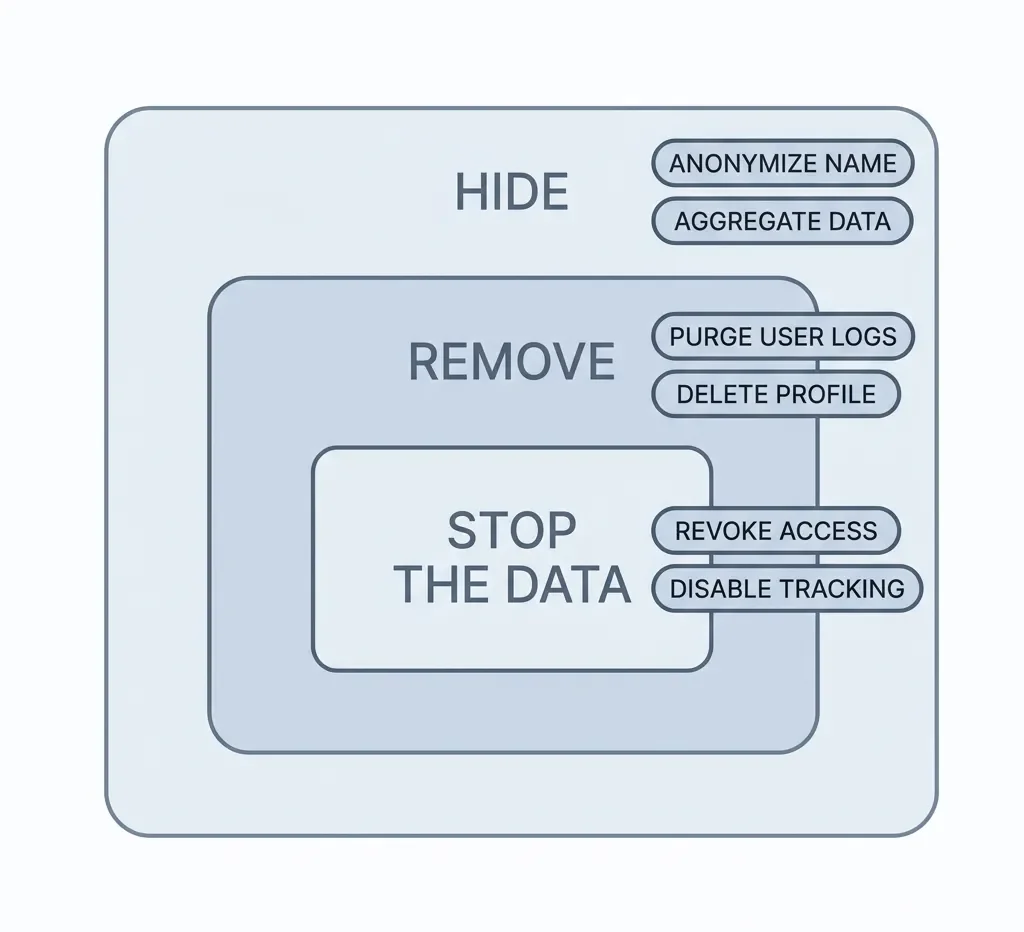
Before you start flipping switches, decide what you're actually trying to achieve. There are three levels here, and they're not the same thing.
Level one: hide it. The assistant switch, the Gmail checkboxes, the Chrome toggles. These remove Gemini from your face. Fast, reversible, and for most people, enough.
Level two: remove it. Deleting the app on iPhone and Mac, or the ADB route on Android. This actually takes the software off your device – with caveats we'll get to.
Level three: stop the data. Every option above controls the feature layer. What Google stores, reviews, and trains on is governed by one separate account setting, and it keeps doing its thing no matter how many buttons you've disabled.
Quick naming note, because it matters for finding these settings later: Gemini is the product formerly known as Bard, renamed in February 2024 – and Google is currently renaming pieces of it again. If a menu in this guide has a slightly different label by the time you read it, that's Google being Google. The settings themselves have been stable; the names, less so.
How to Turn Off Gemini on Android
Some context first, because it explains why Gemini suddenly showed up on your phone: Google is in the middle of upgrading Google Assistant to Gemini as the default assistant on mobile. That rollout was announced in March 2025, was supposed to wrap by the end of that year, and has stretched into 2026. So no – you didn't install it. It was installed at you.
Switch Off Gemini as Your Default Assistant
The official off-ramp is buried in the Gemini app itself, and Google's own support page documents it: open the Gemini app, tap the menu, tap your profile picture, choose "Switch to Google Assistant" and confirm. Done – long-press, power button, and "Hey Google" go back to Assistant. The exact menu naming varies a bit by manufacturer and Android version, but the path is consistently inside the Gemini app's profile menu.
The same support page also documents the halfway options if you want to keep Gemini but stop it from ambushing you: remove it from the power button, turn off "Hey Google" for Gemini, and block it from opening on the lock screen.
What this doesn't do: uninstall anything, or touch your account data. And one honest caveat – since the Assistant-to-Gemini transition is an ongoing rollout, nobody can promise the switch-back option survives forever. Enjoy it while it lasts.
Disable or Uninstall the Gemini App
If Gemini arrived via the Play Store, you can uninstall it like any other app. The catch is that on many phones – Samsung devices in particular – Gemini ships as a system app, and the normal UI only offers Disable, not uninstall. Samsung's own community forum marks full removal as not possible through settings alone.
Disabling works: no launches, no overlays, no notifications. But it leaves the package on the device, and this is where the most common complaint in every forum thread comes in – system updates have re-enabled Gemini for plenty of users, in some cases replacing an Assistant they had deliberately disabled. Treat "check my assistant settings" as a post-update ritual, like checking whether your phone re-enabled Bluetooth. Annoying? Yes. Avoidable? Not really; at least for now.
Completely Remove Gemini with ADB (Advanced)
ADB (Android Debug Bridge) lets you remove the app for your user profile without root. The fun detail: Gemini's internal package is still named after Bard. The widely shared walkthrough goes like this:
Enable Developer options (Settings → About phone → tap Build number seven times), then turn on USB debugging.
Install Google's Platform Tools on your computer, connect the phone, accept the debugging prompt, and verify the connection with adb devices. If nothing shows up, suspect the cable before anything else – a charge-only cable won't register, so use a proper data-rated USB-C cable and try again.
Confirm the package name: adb shell pm list packages | grep bard
Remove it for your user profile: adb shell pm uninstall --user 0 com.google.android.apps.bard
Two warnings. First, this can fail: you might hit a DELETE_FAILED_INTERNAL_ERROR, often on Samsung devices, and usually because the --user 0 flag was missing or the package is locked down by the firmware. Ars Technica's reporting and the comment threads under it are full of device-by-device variation, so test on your own hardware. Second, recovery: you can reinstall from the Play Store, or restore the system copy with adb shell cmd package install-existing com.google.android.apps.bard – a method documented on XDA and widely reported to work, though it's community knowledge, not an official Google procedure. Test on your device before you rely on it.
And even full removal only kills the app. Gemini in Gmail, Chrome, and Search shrugs and carries on – those live on the account layer, not the device.
How to Turn Off Gemini in Gmail, Docs and Google Workspace
On a Personal Google Account
Since January 2025, the AI in Gmail and friends hangs off two settings, and you need to turn off both: in Gmail on the web, click the gear icon → See all settings → General tab. First, uncheck "Turn on smart features in Gmail, Chat, and Meet" and confirm with "Turn off and reload." Then, in the same tab, open "Manage Workspace smart feature settings" and switch off both "Smart features in Google Workspace" and "Smart features in other Google products." The Gmail app has the same checkboxes under Settings → your account. Repeat per Google account – the settings don't sync across accounts.
The honest trade-off: Google's own admin documentation confirms this disables the whole class of smart experiences, not just the AI ones. Users report losing conveniences like Priority Inbox's "Important" sorting along the way – that specific casualty is user-reported rather than officially listed, but it fits how the toggle is designed. You're not unchecking "Gemini." You're unchecking the bundle it ships in. Subtle, and I'd argue not accidental.
One genuinely useful regional quirk: in the EEA, UK, Japan, and Switzerland these smart features are off by default – sitting here in Germany, mine were never on, and checking that box was the first time I'd ever seen the setting. US readers get the opposite deal: everything on until you say otherwise.
As a Workspace Admin
I run my blog and freelance business on Google Workspace, which makes me the world's smallest IT department – admin, user, and help desk, population one. The admin-side switch lives at admin.google.com: Menu → Generative AI → Gemini app → Service status → "Off for everyone" (or per organizational unit, if your org has more people than mine), then Save. Google documents the path here. Gemini inside Gmail, Docs, and the other services has its own panel under Gemini for Workspace → Feature access, where you can switch it off per service – note that this panel only appears on certain Workspace editions.
It wasn't always this civilized. In January 2025, some admins had no Gemini controls at all and had to chat with Google support to get the off switches added to their console. The controls now ship by default – progress, of a sort.
The kicker: Gemini was bundled into Workspace plans in that same January 2025 wave, alongside a price increase. Turning it off does not lower your bill. You're paying for AI you've disabled – my six years of law school would call that an interesting contract structure.
How to Turn Off Gemini on iPhone and Mac
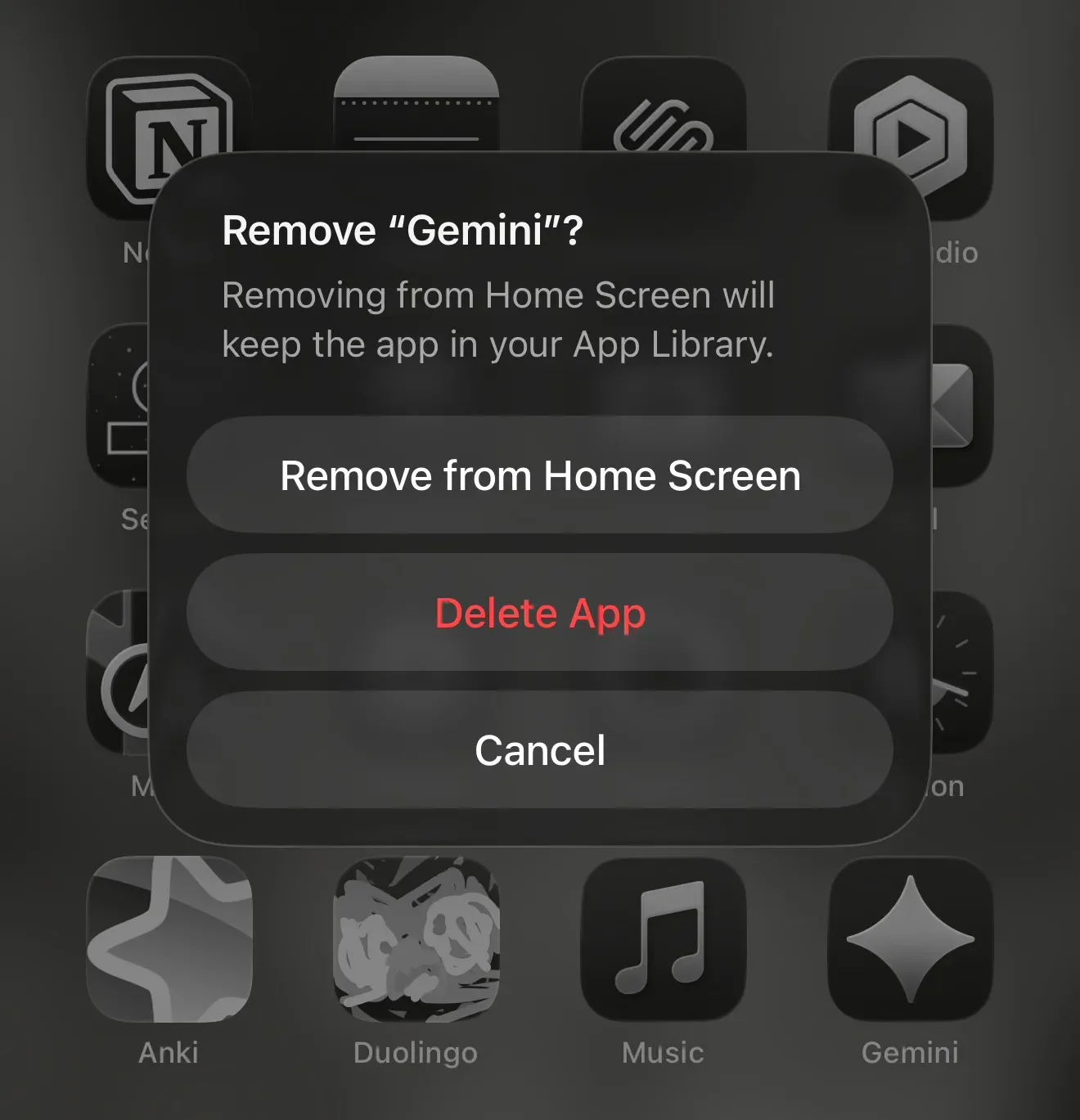
This is the easy section. On iPhone, Gemini is a normal App Store app: long-press the icon, Remove App, delete. No system hooks, no ADB, no drama. Running a tech blog, I’ll say this much: “how do I get rid of this” is a question I see constantly, and on iOS the answer is refreshingly boring.
Same story on the Mac: Google shipped a native Gemini app for macOS in April 2026 (macOS 15 and up, with a global Option+Space overlay), and it's a regular user-installed app. Quit it, drag it to the Trash, and the shortcut dies with it.
Two asterisks. First, deleting the app deletes nothing in your Google account – your chat history lives at myactivity.google.com, and we'll deal with it in the data section below. Second, the layer you can't delete: Apple and Google have announced that the next generation of Siri runs on Apple Foundation Models built on Gemini, processed on-device and on Apple's Private Cloud Compute. Bloomberg reported a figure of roughly $1 billion a year for a 1.2-trillion-parameter model – treat those numbers as reporting, not confirmation. Either way, there's no "remove Gemini from Siri" toggle. The only blunt instrument is turning Apple Intelligence off entirely in Settings, which throws out considerably more than Gemini.
How to Turn Off Gemini in Chrome
Chrome's AI surfaces have multiplied quietly, and the controls are scattered across three places.
Settings → AI innovations: toggle off "Gemini in Chrome," "History search, powered by AI," and "Help me write" – Lifehacker has the click-by-click. Some builds don't show every toggle, which is exactly as confidence-inspiring as it sounds.
Settings → System → On-device AI: this removes the Gemini Nano model that Chrome downloads to your machine without asking. And here's a detail I genuinely appreciate Wired digging up: if you just delete the model file from disk, Chrome silently re-downloads it. The toggle is the only move that sticks.
chrome://flags: the AI Mode button in the address bar doesn't respect any normal setting – you have to set "AI Mode Omnibox entrypoint" to Disabled, per The Register's walkthrough. Flags are experimental by definition, so this one can evaporate in any Chrome update.
And if disabling these features still leaves Chrome feeling too tangled up with your Google identity, the more thorough move is to remove the Google account from Chrome entirely.
How to Turn Off AI Overviews in Google Search
Let's start with Google's official position, because it's admirably blunt: AI Overviews are a core Search feature, and Google's own help pages say these features can't be switched off. That's it. That's the setting. Some accounts can still switch off experimental features via the "AI in Search" toggle in Search Labs, but it's inconsistent and, by many reports, doesn't reliably suppress Overviews – which is why the URL-parameter route below is the dependable one.
What you can do is route around them. Google's Web filter shows a classic links-only results page, and it maps to a URL parameter – udm=14 – that you can bake in as your default.
In Chrome: Settings → Search engine → Manage search engines → Add, with the URL: {google:baseURL}search?q=%s&udm=14.
Ars Technica covered the trick when it surfaced, and tenbluelinks.org maintains per-browser setup instructions. There are also extensions that hide the Overview block with CSS, which works visually and changes nothing underneath.
Be clear-eyed about what this is: a presentation filter, not an off switch. Your queries still go to Google, Overviews still get generated – you just don't see them. For day-to-day sanity, that's usually enough. For principle, it may not be.
How to Stop Gemini Using Your Data (without Turning Anything Off)
Here's the section I'd actually bookmark, because this setting operates independently of every switch above – and it's where my law-school habit of reading retention policies earned its keep. If you want the bigger picture behind why a search company cares this much about your chat logs, The Age of Surveillance Capitalism is the book that reframed how I think about it.
The control is called Gemini Apps Activity – currently being renamed "Keep Activity" – and it lives at myactivity.google.com/product/gemini, or in the Gemini app under your profile. By default it's on, with an 18-month auto-delete. What it governs: whether your chats are stored long-term, sampled for human review, and used to improve Google's models.
Now the fine print, straight from Google's documentation:
Even with Activity off, chats are stored for up to 72 hours to "provide the service and process any feedback."
Conversations that have been sampled for human review are kept for up to three years, disconnected from your account – and deleting your activity does not remove them. Google's own privacy page puts it plainly: don't enter anything "you wouldn't want a reviewer to see."
Turning Activity off also removes access to your saved chat history. People have lost years of conversationsflipping this switch without realizing. Export anything you care about first.
One more change that deserves more attention than it got: since July 2025, Gemini on Android can interact with Phone, Messages, and WhatsApp even when your Activity setting is off. Those app connections have to be disconnected separately at gemini.google.com/apps. And if you're slamming that door, it's worth shutting the same one on Meta's own AI across WhatsApp and Instagram. Opting out once is apparently a lifestyle, not a decision.
If you want a middle path, Temporary Chats are Gemini's incognito mode – not saved to history, not used for training, gone within 72 hours. For the occasional sensitive question, that's a genuinely reasonable compromise.
Should You Turn Gemini Off? What I Switched Off and What I Kept
My own setup, for transparency. My Workspace smart features were off by default thanks to EU rules, and they stayed off. The Gemini app is switched off in my Admin console – a one-person org-wide policy decision I made over coffee. Chrome's AI toggles are off, mostly because I want my browser to be a browser. But the Gemini app itself? Still on my iPhone. I write about this stuff, I need to see what it does – I just run it with Keep Activity off and Temporary Chats for anything I wouldn't pin to a public corkboard.
That's the honest takeaway: this isn't really an on/off question, it's a which level question. If you just want the buttons and summaries out of your face, the surface toggles get you there in twenty minutes. If your concern is data, the Activity setting and the app disconnects matter more than any visible switch – and it's worth thinking clearly about how much to trust these assistants with your data in the first place. And if you want Gemini genuinely gone, only the ADB route gets close – on exactly one platform, with no guarantee it survives the next update. And if the deeper itch is that your devices have just gotten too eager to help in general, Digital Minimalism is a calmer take on deciding what tech earns a place on your home screen.
Whatever level you pick, put a reminder in your calendar to re-check after major updates. The single most consistent theme across every forum thread I read for this guide: the settings don't stay set. Gemini comes back like a houseplant you decided to stop watering – somehow thriving. That's not a bug in your setup. That's the product strategy.
Have you found a setting that actually sticks, or one that keeps flipping itself back on? Tell me which device and which switch in the comments below – I keep this guide current as Google shuffles things around, and reader reports are how I catch the changes fast.
And if you'd rather not babysit Google's settings on your own, I run a tech newsletter that tracks exactly these quiet AI changes: what got switched on, where the off button moved, and whether it's worth your afternoon. You can subscribe here.











FAQ
-
No – they're separate products, and that's exactly why the switch-back exists. Google is replacing Assistant with Gemini as the default mobile assistant, but as covered above, you can still flip back to classic Assistant from inside the Gemini app. The older Assistant is being wound down over time, so treat the switch-back as a reprieve, not a permanent home.
-
No. As I found on my own Workspace account, disabling the Gemini app in the Admin console stops the feature but not the billing – Gemini was bundled into the plan price back in January 2025, and switching it off doesn't unbundle it. You're paying for it whether you use it or not.
-
No, and this one trips people up constantly. Deleting the app on iPhone, Mac, or Android only removes the software from that device – your conversations live on your Google account at myactivity.google.com. To actually clear them, you have to turn off or delete Gemini Apps Activity, which is the separate data setting I cover above.
-
Because disabling isn't the same as removing, and system updates frequently re-enable it. This was the single most common complaint I ran into while researching this guide, Samsung phones especially. The only reliable fix is full removal via ADB, and even that can be undone by a big enough update, which is why a periodic re-check is your friend.
-
Partly. There's no official off switch, but you can tack the udm=14 parameter onto a search URL for a one-off classic results page, or use a browser extension that hides the Overview block visually. Setting it as your default search engine just saves you from doing that every single time.
-
Activity is the global setting: turn it off and Google stops storing your chats long-term (with that 72-hour floor) and also hides your saved history. Temporary Chats is a per-conversation option that keeps a single chat out of your history and out of training, then clears it within 72 hours. Use Activity-off for a blanket policy, Temporary Chats when you only want the occasional sensitive question to vanish.
-
Yes. The off-by-default rule only applies in the EEA, UK, Japan, and Switzerland, which is why mine were never on here in Germany. In the US, both smart-features boxes ship checked, so you'll need to uncheck them yourself as described above.